
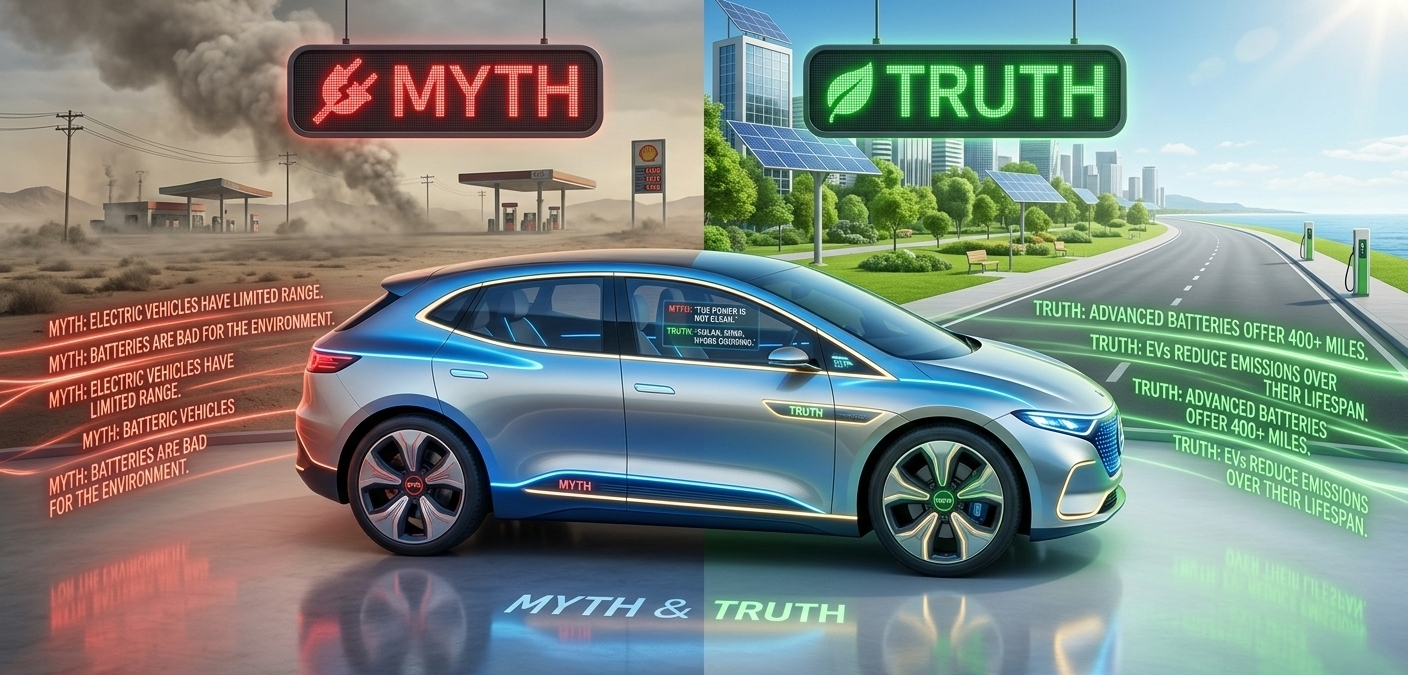
5 EV Myths People Still Believe (And Why They’re Wrong)
Electric vehicles (EVs) are no longer a futuristic concept—they’re becoming mainstream across the world. Governments are supporting them, manufacturers are investing billions into EV technology, and consumers are increasingly choosing electric cars over traditional petrol or diesel vehicles.
Despite this rapid adoption, many misconceptions about EVs still persist. These myths often come from outdated information, early limitations of EV technology, or simple misunderstandings about how electric cars actually work.
If you're considering switching to an electric vehicle—or just want to understand them better—it's important to separate fact from fiction. Here are five of the most common EV myths people still believe and the truth behind them.
Myth 1: Electric Vehicles Don’t Have Enough Range
One of the most common concerns about EVs is range anxiety—the fear that the car will run out of battery before reaching a charging station.
This concern made sense in the early days of electric vehicles. A decade ago, many EVs could only travel about 120–160 km on a full charge. However, modern electric vehicles have dramatically improved.
The Reality
Most modern EVs now offer 300–600 km of range per charge, depending on the model. Some premium models exceed that.
For example:
- Entry-level EVs: ~250–350 km
- Mid-range EVs: ~350–450 km
- Premium EVs: ~500–650 km
For context, the average daily commute in many countries is 30–50 km, meaning most drivers only need to charge their car every few days.
Additionally, EVs are becoming more efficient with better battery technology and smarter energy management systems.
Why This Myth Persists
People often compare EVs to petrol cars without considering daily driving habits. While petrol cars can travel long distances quickly with refueling, most drivers rarely need that capability.
For everyday use, modern EV range is more than sufficient.
Myth 2: Charging an EV Takes Too Long
Another widely believed myth is that charging an electric vehicle takes many hours and is extremely inconvenient.
This assumption comes from thinking that charging is similar to refueling a petrol car, where the entire process happens at a station.
The Reality
EV charging works differently because most charging happens at home.
There are three main types of EV charging:
1. Home Charging (Slow Charging)
- Time: 6–10 hours
- Typically done overnight
- Convenient for daily use
2. AC Public Chargers
- Time: 2–5 hours
- Often found in malls, offices, or parking areas
3. DC Fast Chargers
- Time: 20–40 minutes for 80% charge
- Used for highway travel or long trips
Most EV owners simply plug in their car when they arrive home—just like charging a smartphone overnight.
Why This Myth Persists
People assume they will always need to wait at charging stations. In reality, EV charging often happens passively while the car is parked.
Myth 3: EV Batteries Don’t Last Long
Battery life is one of the biggest concerns for potential EV buyers. Many people worry that the battery will degrade quickly and require expensive replacement.
The Reality
Modern EV batteries are designed to last 8–15 years or more.
Most manufacturers now provide battery warranties between 8 and 10 years, often covering around 160,000 km or more.
Real-world data shows that EV batteries degrade much slower than expected.
Typical degradation rates:
- ~2–3% capacity loss per year
- ~10% loss after 5 years
- ~20% loss after 10+ years
Even after significant degradation, the battery is still usable—it simply stores slightly less energy.
Additionally, old EV batteries can be reused for energy storage systems in homes or power grids.
Why This Myth Persists
Many people compare EV batteries to smartphone batteries, which degrade quickly due to constant full charging cycles. EV battery management systems are far more advanced and designed to minimize degradation.
Myth 4: Electric Vehicles Are Too Expensive
Many people believe EVs are only for wealthy buyers because the upfront cost is higher than traditional vehicles.
The Reality
While EVs can have a higher purchase price, total ownership cost is often lower.
EVs save money in several ways:
1. Lower Fuel Costs
Electricity is typically cheaper than petrol or diesel per kilometer.
2. Less Maintenance
EVs have fewer moving parts. They don’t need:
- Oil changes
- Engine repairs
- Exhaust systems
- Many transmission components
3. Government Incentives
Many countries offer subsidies, tax benefits, or reduced registration fees for EV buyers.
Over 5–8 years of ownership, EVs often become cheaper overall than petrol vehicles.
Why This Myth Persists
Consumers tend to focus only on the purchase price rather than the lifetime cost of ownership.
Myth 5: Electric Vehicles Are Worse for the Environment
Some critics claim EVs are not actually environmentally friendly because battery production and electricity generation can produce emissions.
The Reality
While EV manufacturing does have environmental impacts, studies consistently show that electric vehicles produce significantly fewer lifetime emissions than petrol or diesel cars.
Key reasons include:
1. Zero Tailpipe Emissions
EVs do not produce exhaust pollution while driving.
2. Cleaner Energy Over Time
As electricity grids adopt more renewable energy sources (solar, wind, hydro), EVs automatically become cleaner.
3. Battery Recycling
EV battery recycling technology is improving rapidly, allowing recovery of materials like lithium, nickel, and cobalt.
Even when powered by electricity from fossil fuels, EVs usually produce lower total emissions over their lifetime than internal combustion vehicles.
Why This Myth Persists
Many discussions focus only on battery manufacturing emissions, ignoring the emissions produced during years of petrol or diesel driving.
The Bigger Picture: EV Technology Is Improving Fast
Electric vehicle technology is evolving rapidly. Innovations are happening in several areas:
Battery Technology
- Solid-state batteries
- Higher energy density
- Faster charging speeds
Charging Infrastructure
- Expansion of fast charging networks
- Ultra-fast 350 kW chargers
- Wireless charging research
Vehicle Efficiency
- Improved aerodynamics
- Smarter battery management
- Advanced regenerative braking
These developments mean that many of today’s EV concerns may disappear within the next decade.
Final Thoughts
Electric vehicles have come a long way in a short period of time. Many of the myths people still believe were once valid concerns—but technology has moved forward.
To summarize:
- Modern EVs have longer ranges than most people need
- Charging is more convenient than many expect
- Batteries last longer than early predictions
- Total ownership costs can be lower than petrol vehicles
- EVs generally produce less lifetime pollution
As infrastructure grows and battery technology improves, electric vehicles will continue to become more practical and accessible.
Understanding the truth behind these myths helps consumers make better decisions about the future of transportation.


Comments (0)